Landing Page Vs. Splash Page: Which One Boosts Your Conversions?
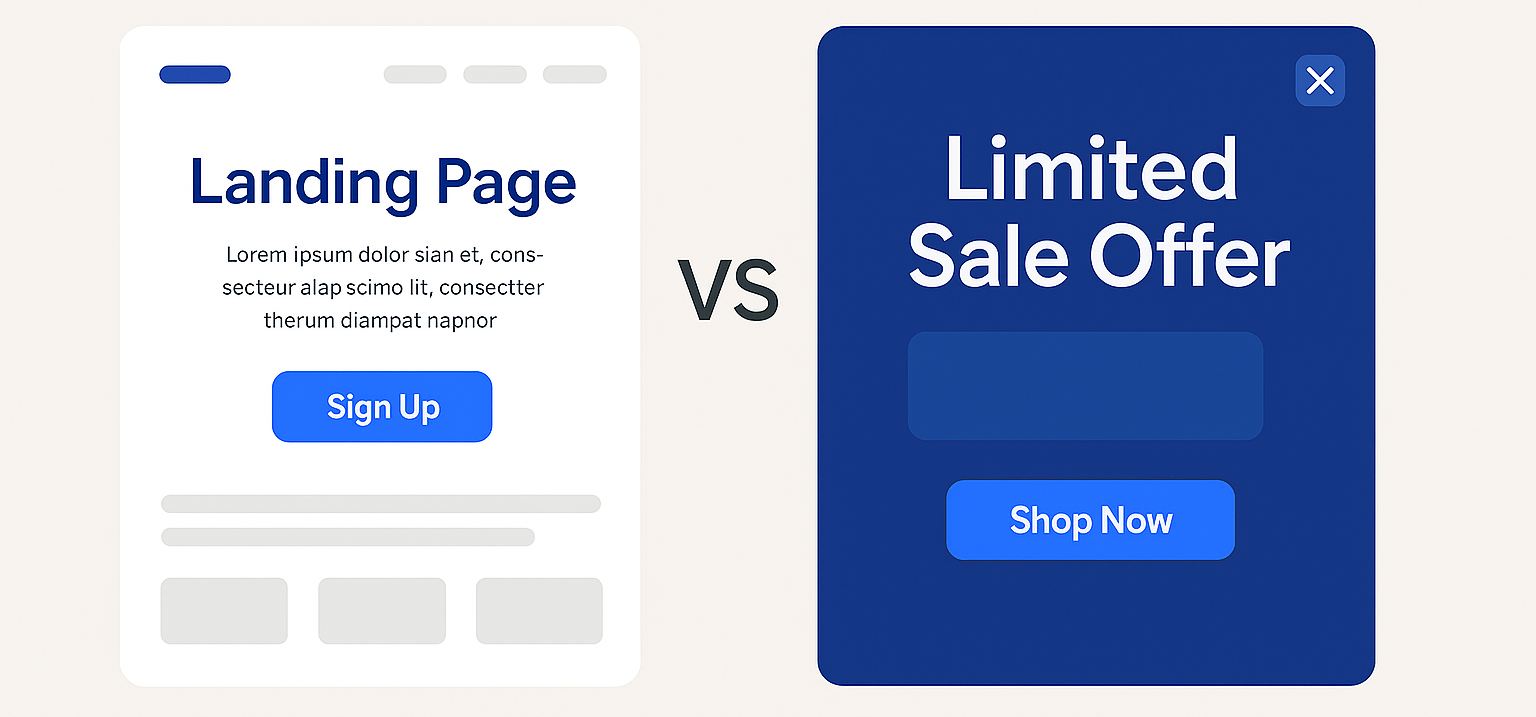
A landing page is a standalone page with one goal: converting visitors into leads, sign-ups, or customers. It removes distractions and focuses on a single call to action. A splash page is a brief introductory screen shown before the main website. It is used for age verification, announcements, or brand introductions. It is not designed to convert. The key difference is that a landing page drives action while a splash page prioritizes branding, announcements, or age verification.
Landing Page vs. Splash Page: Key Differences
Here’s how the two page types compare:
| Feature | Landing Page | Splash Page |
| Primary Purpose | Lead generation, sales, conversions | Brief message, age verification, brand intro |
| Content | Detailed, persuasive copy, CTAs, forms | Minimal text, visual elements, concise message |
| User Interaction | High – guides user to a specific action | Low – usually a single click to proceed |
| Navigation | Focused path, clear CTA | Often, no navigation, just an exit link |
| Duration | Visitors stay to learn & act | Short-lived, quick entry point |
| SEO Impact | Strong, optimized with targeted keywords | Minimal, often ignored by search engines |
| Conversion focus | Yes | No |
Most marketing campaigns fail not because of the offer, but because of the first page visitors see. Send people to the wrong type of page, and you risk losing leads before they even get started. That’s why knowing the difference between a landing page and a splash page is so important. Here are the key differences and best use cases for splash pages and landing pages.

You’ve invested time, money, and effort into your digital marketing campaigns, but your results aren’t matching your expectations. Visitors arrive on your site, yet too many leave without taking action.
Often, the culprit isn’t your ad or your offer; it’s the very first page your audience sees. If you’re sending traffic to the wrong type of page, you could be unintentionally sabotaging your own conversion rates. A confusing or mismatched page can interrupt the user journey, frustrate website visitors, and waste valuable opportunities to connect with potential customers.
Knowing the distinct roles of landing pages and splash pages is crucial for maximizing conversion rates. One is designed to convert visitors into customers, while the other sets the stage with a bold first impression. Used strategically, your pages can either capture leads, drive sign-ups, and boost sales or set the stage with a memorable first impression before visitors dive into your main website.
Key Takeaways:
- Landing pages are highly effective for driving conversions by guiding visitors toward a single, specific action.
- Splash pages act as quick, attention-grabbing intros, which is perfect for age verification, promotions, or branding.
- The choice between a splash page and a landing page directly impacts user experience, SEO, and overall marketing success.
Whether it’s splash pages or full funnels, Convertri gives you the speed and flexibility to launch with confidence.
What Is a Landing Page?
A landing page is a standalone page. It’s designed with one goal in mind: conversion. Unlike other pages on your business website, it removes distractions and focuses on a specific call to action (CTA).

Common uses of landing pages include:
- Collecting sign-ups for newsletters or webinars
- Promoting service promotions or product launches
- Encouraging visitors to download an eBook or free trial
- Driving sales with limited-time offers
Essential elements of high-converting landing pages:
- Compelling headline that captures attention
- Concise, benefits-driven copy
- Relevant visuals or videos
- Social proof (e.g., customer testimonials, trust badges)
- A single CTA button guiding the user flow
For example, a webinar landing page might include the benefits of attending, a registration form, and proof from past attendees. Everything is streamlined to encourage sign-ups.
For paid campaigns, message match between your ad and your landing page is one of the most important conversion variables. A visitor who clicks an ad for free trials should land on a page that leads with that exact offer.
What Is a Splash Page?
A splash page (sometimes called a splash screen or welcome screen) is a brief message that appears before the main site. It’s not meant to persuade deeply but rather to introduce visitors quickly and directly.

Common splash page examples include:
- Age verification before allowing access (e.g., to sell age-restricted products)
- Highlighting a promotional message or seasonal sale
- Delivering a memorable first impression with visuals or animation
- Sharing a short video or high-quality images to set the tone
Unlike a landing page, a website splash page usually has minimal interaction. It’s often just a simple “Enter Site” or exit link.
Which One Converts More Visitors?
The landing page is the clear winner.
- Landing pages are designed for action, as every essential element works toward conversions.
- Dedicated landing pages outperform splash pages in lead generation.
- Landing pages let you collect data, segment audiences, and continually optimize for better conversion rates.
On the other hand, while effective splash pages are great at grabbing attention, they don’t provide enough depth to directly convert visitors into potential customers.
If your goal is leads, sign-ups, or sales, a landing page is the only option worth considering. Every element, the headline, the copy, the social proof, the CTA, serves conversion.
Ready to build lightning-fast landing pages that actually convert?
Pros and Cons of Landing Pages
Advantages
- Higher conversion rates for specific campaigns
- Ability to tailor content for different audiences
- Measurable results from analytics & A/B testing
- Perfect for lead generation and direct sales
Drawbacks
- Requires careful planning and design
- Poor execution can hurt the customer journey
- Managing multiple campaigns means juggling many standalone web pages
Pros and Cons of Splash Pages
Advantages
- Creates a memorable first impression
- Useful for urgent updates or specific messages
- Great for introducing visitors before the main website
- Lightweight and visually appealing
Drawbacks
- Can act as a barrier, delaying access to content
- Risk of frustrating users, especially on a mobile device
- Minimal SEO impact since splash pages serve only briefly
- Rarely supports direct sign-ups or sales
Landing Page vs. Splash Page: When Should You Use Each?
Use a landing page when you need:
- A direct path to sign-ups, downloads, or purchases
- To inform visitors of details about your offer
- To guide the user journey toward a single goal
Use a splash page when you want:
- Quick splash page examples, like age verification or special announcements
- To greet visitors with a specific message before the main site
- To make an impact with high-quality visuals or branding
Bottom Line: If you want conversions, go with a landing page. If you need a welcome screen or one-time announcement, use a splash page.
Optimizing Landing Pages for Conversions

To create high-converting landing pages, focus on:
- Strong headlines and benefits-driven copy
- A clear and bold specific call to action
- Fast-loading design to reduce bounce rates
- Social proof through customer testimonials
- Continuous testing with tools like Convertri’s A/B testing

Tools for Building Landing and Splash Pages
The right tools and templates help you create effective splash pages and high-converting landing pages. The needs of each page type are different, which is why a flexible platform like Convertri is so valuable.
Building splash pages
For splash pages, the goal is speed and simplicity.
- Ideal templates: Lightweight, focused on a compelling visual or a very brief message
- Quick load times: Ensures site visitors aren’t frustrated or lost
- Visual impact: Use high-quality images or animations to create a memorable first impression
Convertri makes this simple with:
- A drag-and-drop builder for pixel-perfect visuals

- Support for adding bold visual elements that greet visitors effectively

- Mobile-friendly design that keeps splash pages fast and smooth

Building landing pages that convert
Landing pages require more depth because they aim to direct visitors toward a specific call to action.
- Comprehensive templates: Include sections for persuasive copy, lead capture forms, and customer testimonials
- Conversion-focused elements: Multiple CTAs, trust badges, and optimized content areas
- Flexibility: Adjust design to fit any campaign objective – sales, sign-ups, or product launches
Convertri supports landing pages with powerful features like:
- AI Landing Page Generation to refine messaging and tailor your value proposition
- A/B Testing to identify which designs drive the highest conversion rates

- EventTracker for detailed tracking of micro-conversions and user behavior
- Fast hosting infrastructure, ensuring your standalone page loads quickly and reduces bounce rates
- Seamless integrations with CRM tools, email marketing platforms, and analytics

Why Choose Convertri?
With Convertri, you get the flexibility to build both splash pages and landing pages without coding. Whether it’s a single-page announcement or a standalone webpage designed to nurture the customer journey, Convertri’s suite of tools ensures speed, performance, and results.
FAQs
Q: What is the primary difference between a splash page and a landing page?
A: The main difference is their purpose:
- A splash page serves as a brief introductory screen for announcements, age verification, or temporary promotions, offering minimal interaction.
- A landing page drives specific user actions, such as sign-ups or purchases. It features detailed content and clear calls to action.
Q: Can a splash page help with lead generation?
A: Generally, splash pages are not designed for direct lead generation. Their brief nature and minimal content make them unsuitable for collecting detailed visitor information or guiding users through a conversion funnel.
Q: How does page speed affect splash pages and landing pages?
A: Page speed is crucial for both, but its impact differs. Slow-loading splash pages can significantly increase bounce rates because visitors quickly lose patience with a temporary barrier. For landing pages, fast load times are critical for maintaining user engagement and improving conversion rates, as every second of delay can lead to a drop-off in potential leads or sales. Convertri emphasizes speed to enhance both page types.
Q: Which is better for a paid marketing campaign: a splash page or a landing page?
A: Landing page, always. Paid campaigns exist to generate a specific outcome: leads, sign-ups, or sales. A landing page is built for exactly that. A splash page cannot capture leads, cannot be meaningfully optimized for conversion, and adds friction between the ad click and the goal.
Parting Thoughts
Both splash pages and landing pages hold distinct values, but their roles in driving conversions are fundamentally different. While a splash page excels at delivering a brief message or performing quick verifications, acting as a welcome screen and teaser, it is the landing page that stands as the undeniable champion for conversion optimization campaigns.
Don’t let your digital efforts fall flat; empower your campaigns with Convertri today.