The Sculptor & The Turtle
Michelangelo.
Depending on when you were born and if you like pineapple on pizza, you’re probably imagining a huge turtle with an orange eye-mask and dual Nunchakus… or… you’re thinking of the master sculptor from Renaissance Italy.
Both very cool, but for our purposes here, we’re talking mainly about the Sculptor, not the Turtle.
As for pineapple on Pizza – it’s obviously a strong YES if you think otherwise, you’re wrong, and that’s fine, I’m still going to tell you how to build a Michelangelo-level funnel.
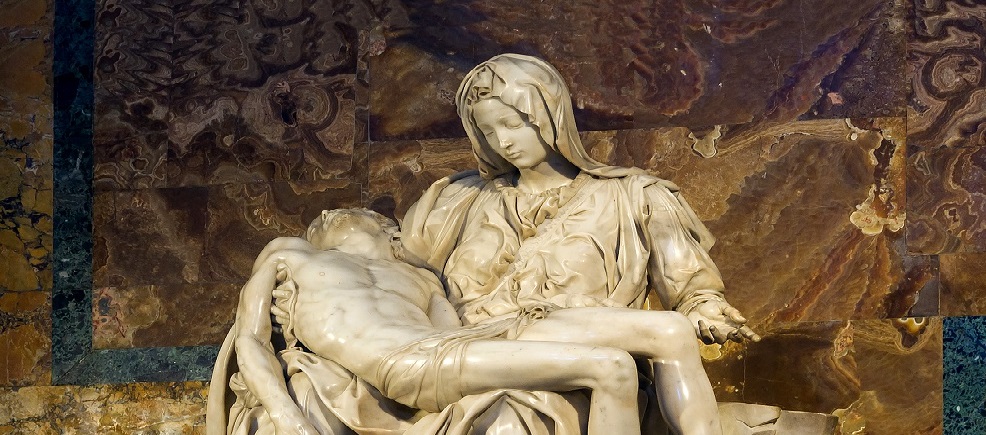
Marble sculpture is incredible.
Up close the detail is so fine that you feel like you can see the pores in the skin.
But what’s really amazing is that a masterpiece like David or Pieta started out as a featureless lump of rock.
And yet, some genius can come along and craft something so monumental it becomes a… well… a monument, to an entire era.
Thankfully, our ambitions are a little less lofty, and a lot more achievable.
How to create a perfect sales funnel for an imperfect world
We just want to create a sales funnel that helps transform the lives of our customers for the better and makes a nice healthy profit for us in the process.
In a perfect world, people come directly to us, cash in hand, asking for our most expensive product or service.
But it’s not a perfect world.
Instead, you have to find people that might be interested in what you’re selling and then convince them that you’ve got the goods they need.
That means building trust and rapport.
Often it means educating prospects on what their actual problem is. Sometimes it means completely breaking down the issue their facing into simple, manageable steps that they need to overcome.
If you put those simple steps into a sales funnel, you can take them from confused, distrusting strangers and transform them into loyal fans, only too happy to spend their money with you.
Do it right, and you’ll have a small percentage of true fans that really will just buy everything you release without question.
Carve out your sales funnel from a featureless hunk of rock
It all starts before you’ve even added the first page to your funnel because the funnel is irrelevant without vision.
Like Michelangelo eyeballing that rock and seeing David hidden inside, you’ve got to look at what you’ve got and have a vision for the funnel inside it.
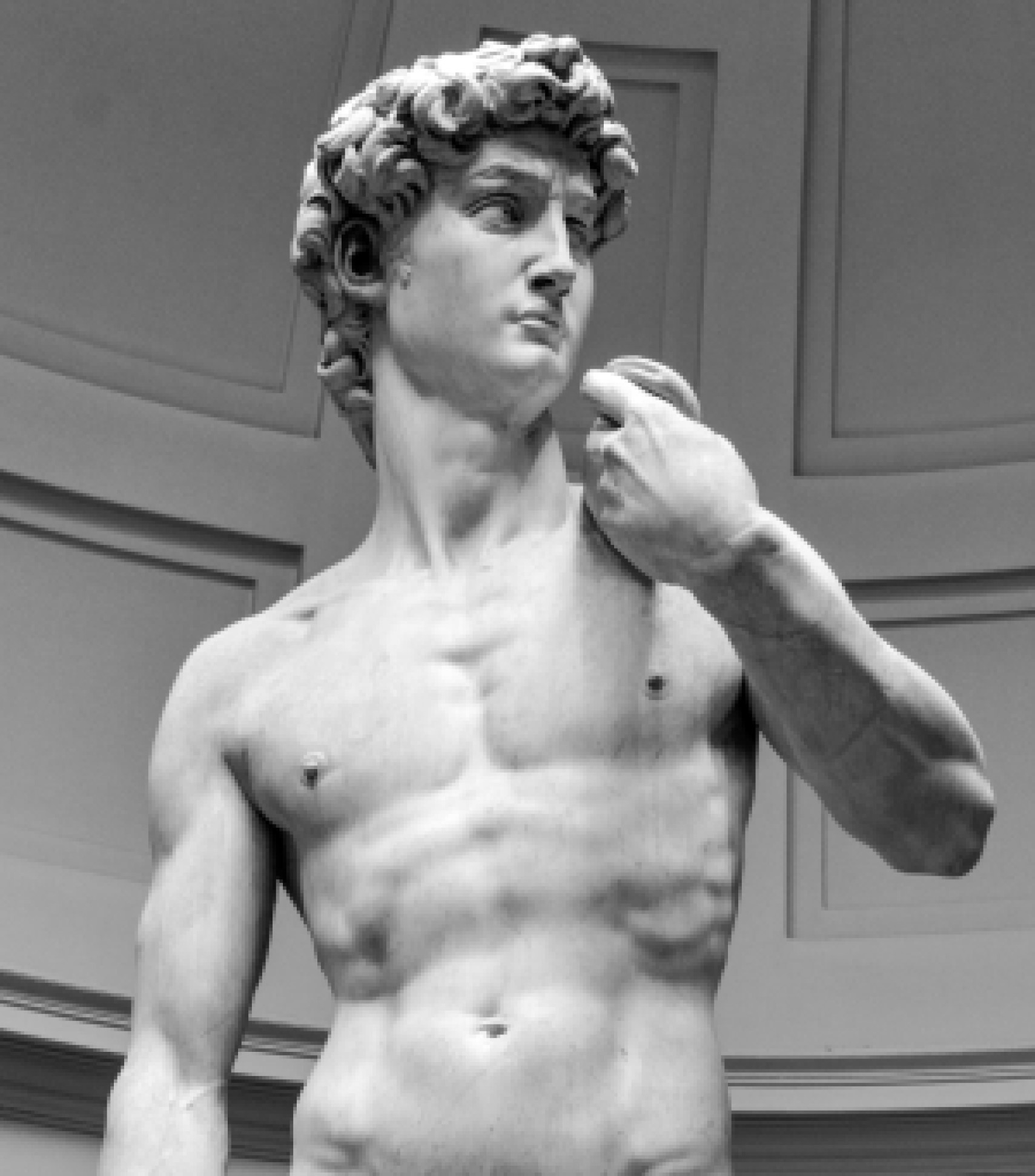 Did you know two other established artists attempted to carve out David from the same bit of marble before Michelangelo had a go?
He’s was totally like:
“What do you mean you can’t do it? You’ve been trying since 1481? It’s too hard, it’s the wrong lump of marble… Rossellino hold my Spritz.”
Because Michelangelo was a visionary and maybe a little tipsy.
Either way, he had the big picture in his mind before he started creating the final product, which in this case was David.
To put that in perspective look at this modern attempt to immortalise one of our own contemporary heroes…
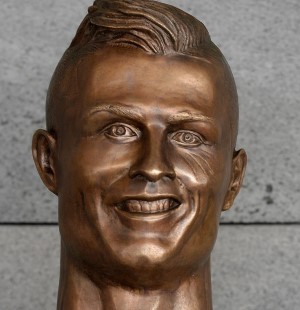
Yikes.
To be fair the forehead is quite good, it looks like it’s done a lot of headers.
Michelangelo started at the end, then worked backwards. This looks like Emanuel Santos started at the backside and turned it into a face.
You may already have a vision of what your main product is going to be, or you may be started with a completely clean slate.
Either way, when it comes to planning your funnel, it all starts with your customers.
And remember, you are not your customer. Don’t fall victim to the curse of knowledge. Just because a problem and solution obvious to you, it doesn’t mean it’s obvious to your customer. If it was, they wouldn’t need you.
Begin by empathising with your prospect. Walk in their shoes. Feel what they are feeling. Only then can you begin to get a sense of the smaller steps needed to encourage them to invest in you and your main product.
This is a process of chipping away at the various layers and assumptions involved in your main product until it reveals the funnel.
T.U.R.T.L.E Power
And this is true for the turtle too, right? 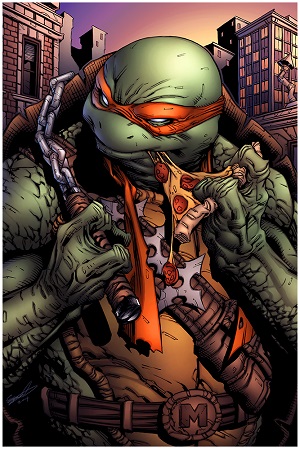
He didn’t get to be a ninja overnight. He needed a funnel, carefully constructed by Splinter to train him in clearly demarcated steps over time. Before that, he was just a teenage mutant turtle, which is just offensive.
It’s the whole Miyagi/Daniel-San thing.
He went through a funnel too.
Wax-on, wax-off. Paint-on, Paint-off. Sweep the porch…
Then he put it all together and crane kicked the crap out of that Cobra Kai punk Johnny Lawrence in the final scene…
But he couldn’t have done that or even known to ask how to do it before he’d learnt all that wax-on, wax-off stuff in Miyagi’s funnel.
Ok. Here’s where we’re at:
- Miyagi – big picture – logical sequence of steps – ultimate victory
- Splinter – big picture – logical sequence of steps – ultimate victory
- Michelangelo – big picture – logical sequence of steps – ultimate victory
- You – big picture – logical sequence of steps – ultimate victory
An example of funnel-building that you can use
Recently, I was writing a more involved funnel guide.
In it, I used an example of a bride who’s in a panic. She’s scared she won’t fit into her grandmother’s wedding dress on her wedding day, which I am told is the appropriate time to wear such a garment.
That’s a significant problem with a lot of pain built into it.
Even so, Anna (the bride) doesn’t know you or your brand, or your service. So, you can’t just interrupt her day on Facebook and ask her for $997 to coach her to lose the weight in time.
First, you need to build trust and rapport – because $997 is a lot of money to ask someone for when they’re half-way through planning an 80k wedding.
But if you come at this problem a different way, via a funnel, you can make that $997 seem like the bargain of the century.
Here’s how I think about this problem, and this is thinking you can apply to just about any funnel
Anna is getting married in the next few months. She wants to lose enough weight before then to be able to fit into her grandmother’s wedding dress and look beautiful in her wedding photos.
On the way, Anna’s going to run into some roadblocks that stop her getting the result she wants.
But she doesn’t have much time, and she doesn’t want to spend too much money unless she knows it’s going to get results.
If we can convince her that she’s going to get the results she’s after, then $997 stops being a big expense and becomes a drop in the ocean compared to the 80k she’s already spending on the wedding.
Which means we need to transform Anna’s thinking before we can transform her weight.
To do this, we need to start at the end of this funnel.
The final product is a 90-day personal coaching program for $997 that’ll get Anna into her wedding dress. But before we can get her there, we need to identify all the roadblocks she might encounter trying to do it herself.
We’ve done our research, so we know the kind of things people like Anna struggle with. Which means we can put them into some kind of logical order to take a prospect from scared, panicked and uninformed to comfortable, confident and transformed.
People don’t know what they don’t know
The initial problem to overcome is people don’t know what they don’t know.
They don’t even know what questions to ask to get the ball rolling.
All they know is that they are in pain. In this instance, Anna is facing a lot of perceived humiliation and embarrassment.
The reality is more complex. Those feelings of fear and pain are very real, and we could fix them with our main product if only Anna could see the value in it.
But where Anna is at right now, all she can see is an insurmountable problem. She’s no idea about meal planning or the importance of nutrition, and because she’s not got the required level of understanding, a solution based on them is doomed to failure, as they hold zero value.
We can see the value. Anna can’t.
It always starts with empathy
It’s our job to help Anna see the real problems she’s facing, and then ask us for the solution.
Which is why we start with empathy.
Where is Anna at, and what is she feeling?
- Fear – that she’s going to let down her hubby on the big day and ruin their wedding pictures.
- Time – is too short to make any kind of difference so she might as well give up.
- Money – is already tight due to the wedding and so she’s feeling guilty at wanting to use more of it just to look good.
- Embarrassed – that she’s no idea about cooking, meal planning or nutrition.
- Lack of motivation or self-belief – that she can make the changes she needs to make.
These are made-up feelings to illustrate the problems she is facing. The reality is likely far more complex, but what we definitely do know is what Anna isn’t thinking…
Anna’s not thinking:
“Oh, gosh I need to do a quick study of food nutrition, macros, HR zones, and neuromuscular exercise, then go out and plan what I’m going to eat every day for the next 90 days.”
We know she’s not thinking that, because she can’t.
She wouldn’t know where to start. She doesn’t have the understanding or the vocabulary to ask these questions. It’s our job to get her there as quickly, easily, and generously as possible.
Because when we get her there, she’ll see the value in our main product, and then we’ll be able to help her get where she needs to be.
Setting up roadblocks
So, what we need to do is create a funnel that allows us to talk to Anna, build trust, and educate her on the problems she’s going to face in getting ready for her big day.
We can organise these problems into roadblocks, then sell individual solutions to overcoming those roadblocks.
Stating with the big picture in mind…
- Fear – that she’s going to let down her hubby on the big day and ruin their wedding pictures.
- Time – is too short to make any kind of difference so she might as well give up.
- Money – is already tight due to the wedding and so she’s feeling guilty at wanting to use more of it just to look good.
- Embarrassed – that she’s no idea about cooking, meal planning or nutrition.
- Lack of motivation or self-belief – that she can make the changes she needs to make.
Overcoming roadblocks
Using those roadblocks, we’ll give each one a fix, then organise them into a logical sequence that’s best for Anna.
Our aim is always to fix the immediate problem, build trust, and be educating Anna on the bigger issue or other roadblocks she’s about to face, building tension then offering the next solution.
Here’s what it looks like as a list:
- Main Problem: Fear that she’s going to let everyone down and ruin the wedding pictures.
Solution: A 90-Day One-On-One Coaching package with high-level exercise and nutritional advice, daily check-ins, and done-for-you meal planning, recipes and shopping lists. - Roadblock 3: Lack of motivation or self-belief.
Solution: Accountability group to overcome a lack of willpower and self-belief, by being surrounded by people in the same position and brides that went through the course and have come back to offer moral support. - Roadblock 2: Embarrassed about lack of cooking of meal planning knowledge.
Solution: A guide on meal planning and preparation. - Roadblock 1: Time is too short, and money is too tight.
Solution: A simple free report on foods to eat to lose weight fast.
Here’s how this looks in real life
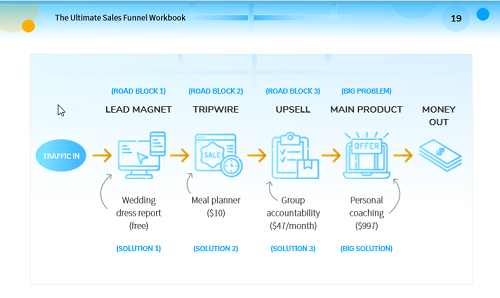 The Lead Magnet…
It starts at roadblock 1, with a simple product that is cheap or free, easy to understand, helpful for her current level of understanding, and educational enough to get her asking better questions.
In this instance, we want Anna to give us her email address, but we know she’s short on time and money, so we’re going to make a guide that’s free and easy to consume. And we know she’s not at the level where we can dazzle her with our expertise on nutrition or exercise. So, we’re going to make it something that she can instantly understand and get good results from.
For this, we’ve chosen to give her a list of 5 foods to start eating and 5 foods to stop eating or cut down on.
So, 10 foods each with an explanation of why they’re good or bad, with a low level of technical jargon to signal to Anna that we know what we’re talking about.
We’ll also build both empathy and tension by talking about how hard it is to diet, especially when you’re stressed, and how the fastest results come from meal planning.
We can also put in a nice little hook that suggests meal planning is a way to save a lot of money while still eating really well.
That sets up Anna’s second roadblock (not knowing how to cook or what to eat) and our tripwire solution: a meal plan and preparation guide.
And that, in a half-shell, is your perfect information-based lead magnet.
It builds trust, authority, it relieves tension in the form of answers, then adds a little more tension in the form of questions by revealing a newer, deeper, slightly more complex problem. Then promises to relieve the new tension by providing a slightly more detailed higher-priced answer.
The Tripwire…
The tripwire does the same thing as the lead magnet, but with an added layer of complexity and has bigger more robust answers to their problems. Again, building trust, rapport, loyalty, and solving the promised problem, while exposing a new one, for a slightly higher price.
Anna clicks the link in our 10-food checklist and buys our meal planner tripwire product.
Now she’s learning about a slightly higher level of nutrition, what foods work and why, and how to prepare them. We can add in a recipe list, and nutritional tables so she can begin to understand macros and calorific intake and talk about meal timing and resting metabolic rate.
She won’t get a high-level understanding, but she’ll get the layman’s level understanding, which means she’ll understand that these things are important. And she’ll know enough to ask questions about how to make these things work for her.
Make no mistake, your tripwire should be top quality.
We’ll make sure to dedicate a section to talking about the mental game of weight loss, especially under stress and the critical importance of accountability. This’ll set up our accountability group (roadblock/solution 3) where Anna can get support and hear first-hand from people like her who have had success thanks to our coaching.
Now Anna can go it alone with these resources we’ve given her, or she can step up and get that social accountability.
The Upsell…
Guess what? Now Anna has decided she trust us and our products enough, she’s going to sign up for our accountability group.
When she does, the same process repeats all over again, just up one level, with extra complexity, and first-hand accounts of how amazing your coaching is, from real people going through the same process, and newly married brides who overcame all these obstacles, thanks to our coaching.
That’s powerful juju. And now we’re first in line when it comes to personal coaching.
The Main Product…
Now Anna is educated and understands the importance of nutrition, meal planning, and accountability.
Now she has seen results first-hand in others just like her.
Now she can see a future where she’s going to fit into that dress, and she trusts us to take her there.
Now she has the vocabulary that when we tell her what we can do for her, it makes perfect sense.
She also understands that as a professional we’re uniquely qualified to help her get the results she’s craving.
$997 is no longer an extra wedding expense she can’t justify. Instead, it’s an absolute necessity. It’s more than worth it to get us to coach her personally for the most important day of her life.
It’s now up to us to deliver our masterpiece.
We’ve chipped away at all the layers, all the roadblocks, all the problems. We’ve educated Anna on why our way works, and why it’s her best interest to follow our way.
We’ve given her the confidence, accountability, the strategy and support to do it herself.
So we’ve already massively over-delivered on our promises, but if she wants to guarantee success, she knows where we are.
If not, if that’s a leap too far, then we’ve still covered our ad costs with our tripwire, and hopefully made enough profit with our upsell to keep honing our funnel and finding people to help.
Wrapping up…
Convertri makes technical part of building the funnel easy, but building a successful sales funnel means understanding your customer.
It means starting at the end and working backwards. Chipping away at the layers of your grand idea to find smaller critical solutions to peoples’ big issues.
Along the way, you build authority, trust and rapport, and a history of overdelivering on your promises.
You also develop a random prospect into a loyal customer who is educated and asking the right questions. Questions that you can now answer at a level that’s genuinely useful to them, and offers them the highest value, which is reflected in the high price of your main product or service.
That’s how you build David. And that’s how you sell him time and again.
If you’d like a deeper dive into sales funnels we have popular 4-part funnel guide that you can dig into right here.